


Planning Diwali gifts for your clients, partners, or employees?
We’ll help you choose Diwali gifts that fit your budget and brand—quick, simple, and hassle-free. Just reach out to our team and we’ll take care of the rest.
 4.8 out of 5 ★★★★★ by 1100+ brands
 How much of your corporate gifting budget is actually tax-deductible under Indian law?
From Diwali hampers to onboarding kits and premium client gifts, companies are spending more thoughtfully on gifting than ever before. But here is what often gets missed: not every corporate gift qualifies as a tax deduction.
Get it wrong, and you could be sitting on disallowed expenses, GST complications, or a weakened claim during assessment.
So what separates a smart gifting expense from a costly one? The dos and don’ts of corporate gifting taxes in India come down to intent, reasonableness, and documentation. This guide breaks down exactly what the law says about corporat
What You Need to Know
- Corporate gifts are tax-deductible under Section 37(1) only if the expense is wholly for business purposes, like client relations, employee welfare, or brand promotion
- Employee gifts up to ₹5,000/year are tax-free; anything above is a taxable perquisite, though the employer can still deduct it
- GST input tax credit is generally not available on gifts given without consideration, and income tax and GST rules must be evaluated separately
- There is no fixed upper limit on deductible gift value, but excessive or unjustified amounts attract scrutiny
- Missing documentation like invoices, recipient records, and stated purpose can get even valid claims disallowed during assessment
- Strategic, consistent gifting tied to business goals is easier to justify and more tax-efficient than ad-hoc spending
What are Corporate Gifts as a Business Expense
In accounting terms, corporate gifts are usually classified as business promotion or employee welfare expenses. However, not every expense automatically qualifies for a tax deduction.
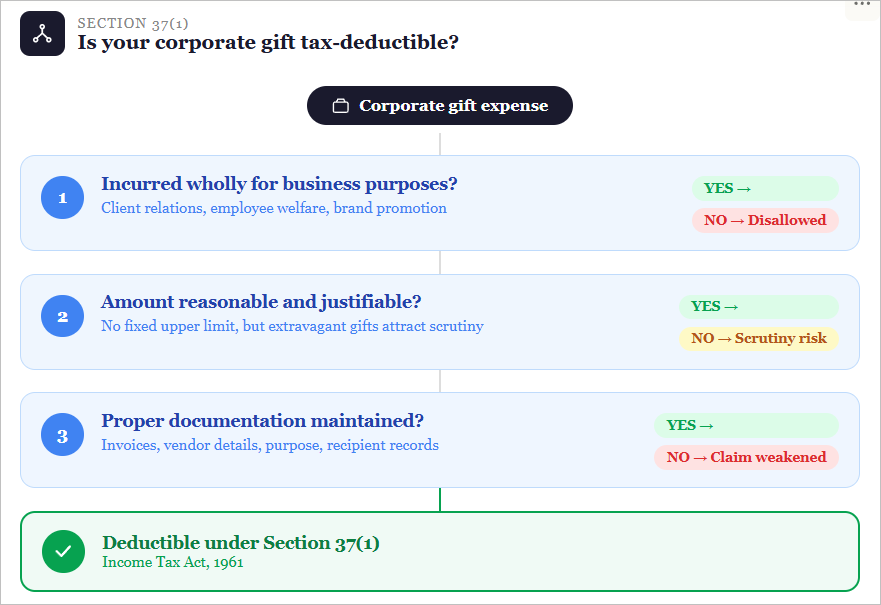
Under Indian tax laws, the primary governing provision is Section 37(1) of the Income Tax Act, 1961, which allows deductions for expenses that are incurred wholly and exclusively for business purposes.
This means the intent behind the gift matters just as much as the gift itself. If the expense is linked to improving business relationships, enhancing employee satisfaction, or promoting the brand, it is more likely to qualify.
On the other hand, if the gift appears personal, excessive, or unrelated to business activities, it may be disallowed during tax assessment.
Tax Deductibility of Corporate Gifts to Clients
Gifting clients is a common business practice, especially during festive seasons or after closing important deals. From a tax standpoint, such gifts are generally deductible if they are reasonable and clearly tied to business objectives.
For example, a company sending curated gift hampers to long-term clients during Diwali can justify the expense as a relationship-building effort. Similarly, branded merchandise given at events or conferences is considered a promotional expense.
However, the line is drawn when gifts become extravagant or unrelated to business outcomes. A luxury personal item with no clear business rationale may raise questions during scrutiny.
What matters most is the ability to demonstrate intent. Maintaining proper documentation, including invoices and a clear record of recipients, strengthens your claim significantly.
Tax Treatment of Employee Gifts
When it comes to employees, corporate gifting is treated slightly differently. While companies can claim these expenses as deductions, there are implications for the employee as well.
Gifts given to employees up to ₹5,000 in a financial year are not taxable in their hands. This makes small festive gifts or occasional rewards a tax-efficient way to boost morale.
Once the value exceeds ₹5,000, the amount is treated as a taxable perquisite for the employee. The employer can still claim the expense as a deduction, but the employee may need to pay tax on the excess value.
This distinction is important when designing employee gifting programs, especially for larger teams or high-value rewards.
GST Implications on Corporate Gifting
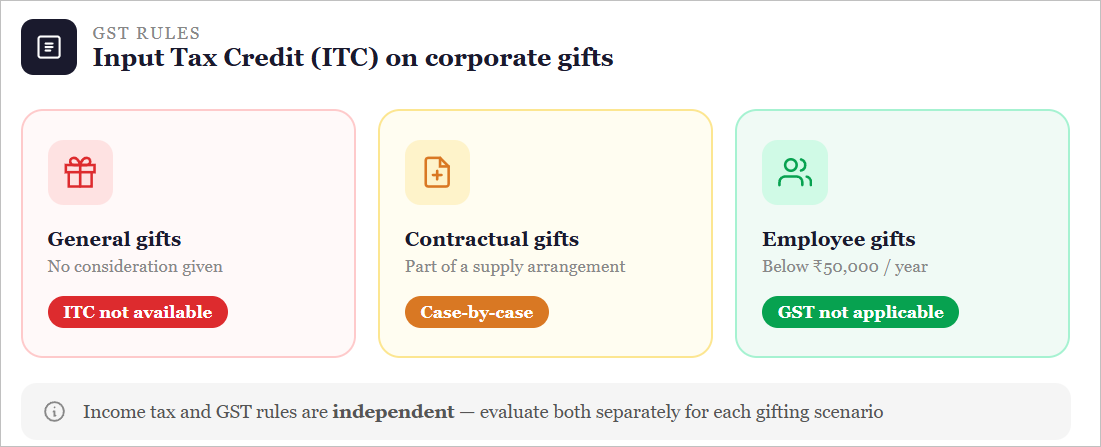
While income tax allows deductions under certain conditions, GST rules introduce additional complexity.
One of the most important aspects is Input Tax Credit (ITC). In general, ITC is not available on goods that are given away as gifts without consideration. This means businesses cannot claim GST credit on many corporate gifts, even if they are used for business purposes.
There are exceptions, particularly when gifts are part of a contractual obligation or included as part of a supply. However, these scenarios are more nuanced and require careful evaluation.
For employee gifts, GST is not applicable if the value does not exceed ₹50,000 per employee in a financial year. Beyond that threshold, GST may apply, depending on the nature of the transaction.
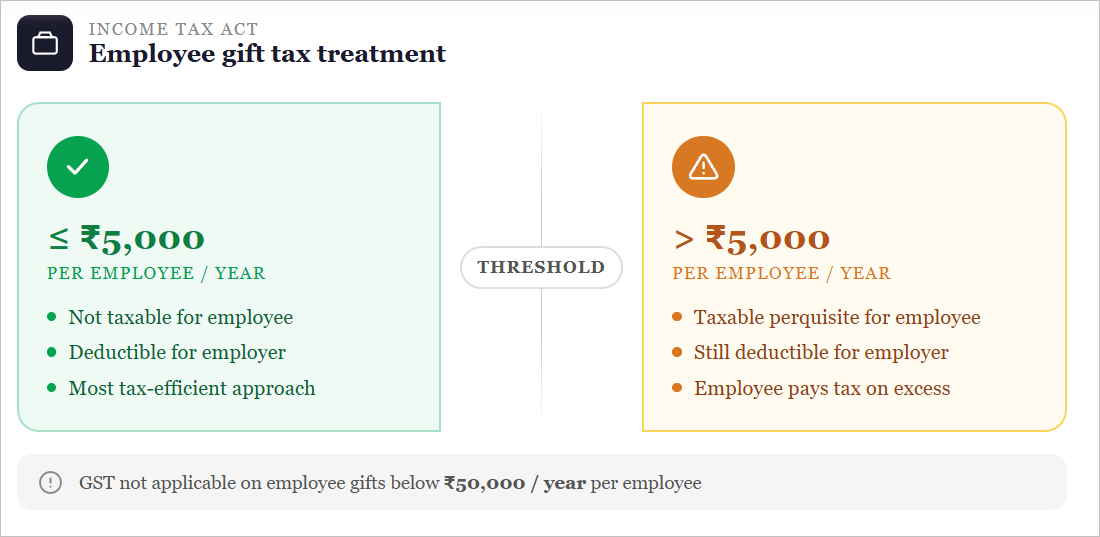
Because GST treatment can differ from income tax rules, businesses need to evaluate both independently rather than assuming a single approach applies to all.
The Importance of Documentation and Compliance
One of the most overlooked aspects of corporate gifting is documentation. Even legitimate business expenses can be disallowed if they are not properly recorded.
Maintaining detailed records ensures that your gifting expenses hold up during audits or assessments. This includes invoices from vendors, a clear description of the items purchased, and the purpose of the expense.
In cases where gifts are distributed to specific clients or employees, maintaining a basic record of recipients adds another layer of credibility. For larger organizations, internal approvals and budget justifications further strengthen compliance.
Good documentation not only supports tax claims but also brings clarity and structure to your overall gifting strategy.
How to Make Corporate Gifting Tax-Efficient
Corporate gifting doesn’t have to be just an expense it can be a well-planned investment.
Businesses that approach gifting strategically tend to benefit more, both in terms of impact and tax efficiency. The key lies in aligning gifting decisions with business goals rather than treating them as random or ad-hoc expenses.
Choosing practical and brand-relevant gifts, planning budgets in advance, and working with experienced vendors can significantly improve outcomes. It also reduces the chances of non-compliance or unnecessary tax complications.
Another important factor is consistency. When gifting becomes part of a structured engagement or marketing effort, it is easier to justify from a tax perspective.
Common Mistakes Businesses Should Avoid
Despite clear guidelines, many businesses make avoidable mistakes when it comes to corporate gifting and taxation.
One of the most common issues is treating personal or informal gifts as business expenses. Without a clear business purpose, such expenses are unlikely to be allowed.
Another frequent mistake is ignoring GST implications altogether. Many companies assume that if an expense is deductible under income tax, it automatically qualifies for GST benefits, which is not the case.
Lack of documentation is another major concern. Missing invoices, unclear records, or incomplete data can weaken even valid claims.
Overspending without justification is also risky. While there is no fixed upper limit on gift value, expenses that appear excessive may attract scrutiny.
Being mindful of these pitfalls can save businesses from complications during tax assessments.
Why Corporate Gifting Continues to Be Valuable
Even with tax rules and compliance requirements, corporate gifting remains a powerful business tool.
It creates a sense of appreciation and goodwill that emails and meetings often cannot achieve. For clients, it reinforces relationships and keeps your brand top of mind. For employees, it boosts morale and fosters a sense of belonging.
In a competitive business environment, these intangible benefits often translate into long-term value.
When combined with proper planning and compliance, corporate gifting becomes not just a thoughtful gesture but also a financially sensible decision.
Partnering with the Right Corporate Gifting Company
Executing a successful gifting strategy at scale requires more than just good intent. It demands variety, customization, reliable delivery, and consistent quality.
This is where working with an experienced corporate gifting partner becomes essential.
TapWell, one of India’s leading corporate gifting companies, has built a strong reputation for helping businesses simplify and scale their gifting efforts.
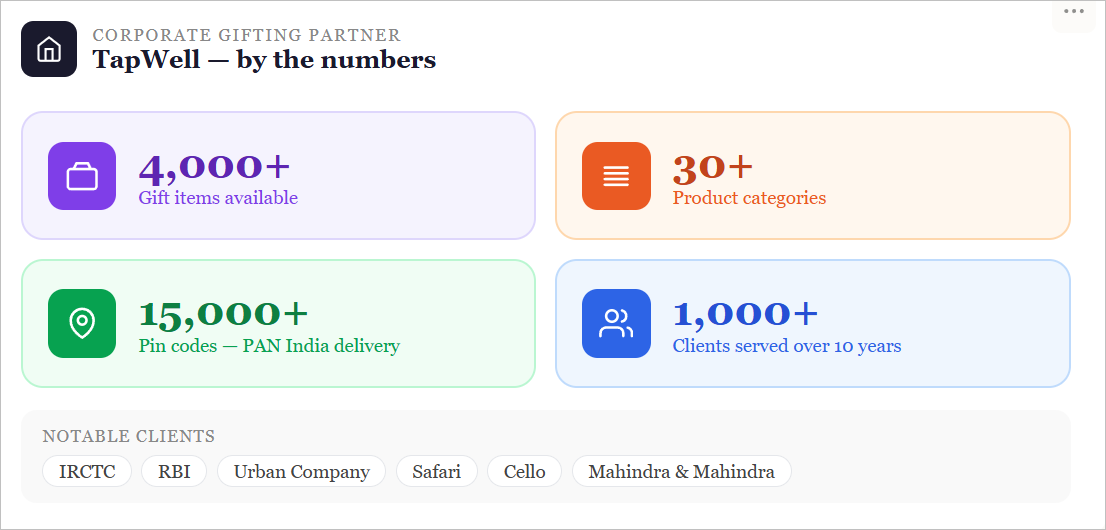
With over 4000+ corporate gift items across 30+ categories, businesses can find options that suit different occasions, budgets, and audiences. Their PAN India delivery network covers more than 15,000 pin codes, ensuring seamless execution even for distributed teams and clients.
What makes TapWell especially relevant for startups and growing businesses is their low minimum order quantities (MOQs), making high-quality gifting accessible without large upfront commitments.
Over the past decade, TapWell has served 1000+ clients, including reputed organizations like IRCTC, RBI, Urban Company, Safari, Cello, and Mahindra & Mahindra.
From curated festive hampers to fully customized branded merchandise, TapWell enables businesses to create meaningful gifting experiences while maintaining operational ease.
👉 Request A Corporate Gifting Quote
Frequently Asked Questions (FAQs)
Are corporate gifts fully tax-deductible in India?
Corporate gifts are not automatically fully deductible. They are allowed as deductions only if they qualify as business expenses under Section 37(1) of the Income Tax Act. The key requirement is that the expense must be incurred wholly and exclusively for business purposes.
Is there a maximum limit on corporate gift deductions?
There is no fixed monetary limit defined under the Income Tax Act for corporate gift deductions. However, the expense must be reasonable and justifiable. Excessive or extravagant gifts may be disallowed during tax assessment.
Are gifts to employees taxable?
Gifts up to ₹5,000 per year are not taxable for employees. Any amount exceeding this limit is treated as a taxable perquisite in the hands of the employee, although the employer can still claim it as a business expense.
Can businesses claim GST input tax credit on corporate gifts?
In most cases, GST input tax credit is not available on corporate gifts given without consideration. Businesses need to evaluate specific scenarios carefully, especially when gifts are part of contractual obligations.
What records should businesses maintain for corporate gifting?
Businesses should maintain invoices, details of the vendor, purpose of the gift, and where possible, information about recipients. Proper documentation helps justify the expense during audits or assessments.
Can small businesses also benefit from corporate gifting?
Absolutely. Corporate gifting is not limited to large enterprises. With the availability of low MOQs and scalable solutions, even startups and small businesses can use gifting as a strategic tool for growth and relationship-building.