


Planning Diwali gifts for your clients, partners, or employees?
We’ll help you choose Diwali gifts that fit your budget and brand—quick, simple, and hassle-free. Just reach out to our team and we’ll take care of the rest.
 4.8 out of 5 ★★★★★ by 1100+ brands
 TL;DR
- Corporate gifting often gets rejected because it is seen as a cost, not a strategy.
- When you show a clear purpose, target the right people, and present structured budgets, approval becomes easier.
- Gifting directly impacts retention, engagement, and client loyalty, which ties to revenue.
- Treat it like a business investment with measurable outcomes, not an optional activity.
Getting approval for a corporate gifting budget feels harder than it should, right?
You know it helps improve employee morale and strengthen client relationships, but leadership often sees it as a non-essential expense. Without a clear structure, your request gets delayed, reduced, or rejected.
The real issue is not the budget itself. It is how the proposal is presented. When gifting lacks a clear purpose, defined numbers, and expected returns, it looks like a cost with no measurable value. This leads to missed opportunities in retention, engagement, and client loyalty.
The good news is that approval becomes much easier when you treat gifting like a business strategy. In this guide, you will learn how to present it with clear intent, structured budgets, and real ROI so leadership sees it as an investment, not an expense.
1. Start with a clear purpose
You should always begin your proposal by clearly defining why corporate gifting is needed. Without a strong purpose, leadership may see it as an unnecessary expense that does not directly contribute to business outcomes. Instead of presenting gifting as a general activity, position it as a solution to specific challenges within the organization.
For example, if employee attrition is rising, you can present gifting as a way to improve recognition and retention. If client relationships need strengthening, you can position gifting as a tool to improve loyalty and engagement.
Corporate gifting is most effective when it is tied to intent. It is not about giving items, but about creating meaningful touchpoints that support business goals like retention, engagement, and relationship building.
2. Show business impact
After establishing the purpose, you need to clearly explain the business impact of corporate gifting. This is where most approvals are won or lost. Decision makers want to see how the proposed budget will contribute to measurable outcomes.
You should explain how gifting helps reduce employee turnover by making employees feel valued, which directly reduces hiring and training costs. At the same time, gifting strengthens client relationships, which can lead to higher retention and repeat business.
There is strong evidence that corporate gifting delivers measurable returns. For example, structured gifting programs have been shown to improve client retention by up to 47% and increase customer lifetime value by more than 300%.
You can also present simple internal examples to make this more relatable. If a small gifting initiative helps retain even one high-value client or improves employee satisfaction scores, the return often exceeds the initial investment. This approach shifts the conversation from cost to value.
3. Define who will receive gifts
A well-structured proposal clearly defines who will receive the gifts and why. A common mistake is to suggest gifting for everyone without prioritization, which can make the plan look expensive and unfocused. Instead, you should segment your audience based on their impact on the business. For employees, you can focus on top performers, long-serving team members, and milestone achievements. For clients, you can prioritize high value accounts, long term partnerships, and strategic prospects.
Segmentation ensures that the budget is used where it creates the highest impact. It also shows leadership that you are not overspending but making calculated decisions. Companies that follow this approach typically focus on contributors who directly support business growth and long term value.
When you clearly define recipients, your proposal becomes more targeted and credible.
4. Create a simple budget plan
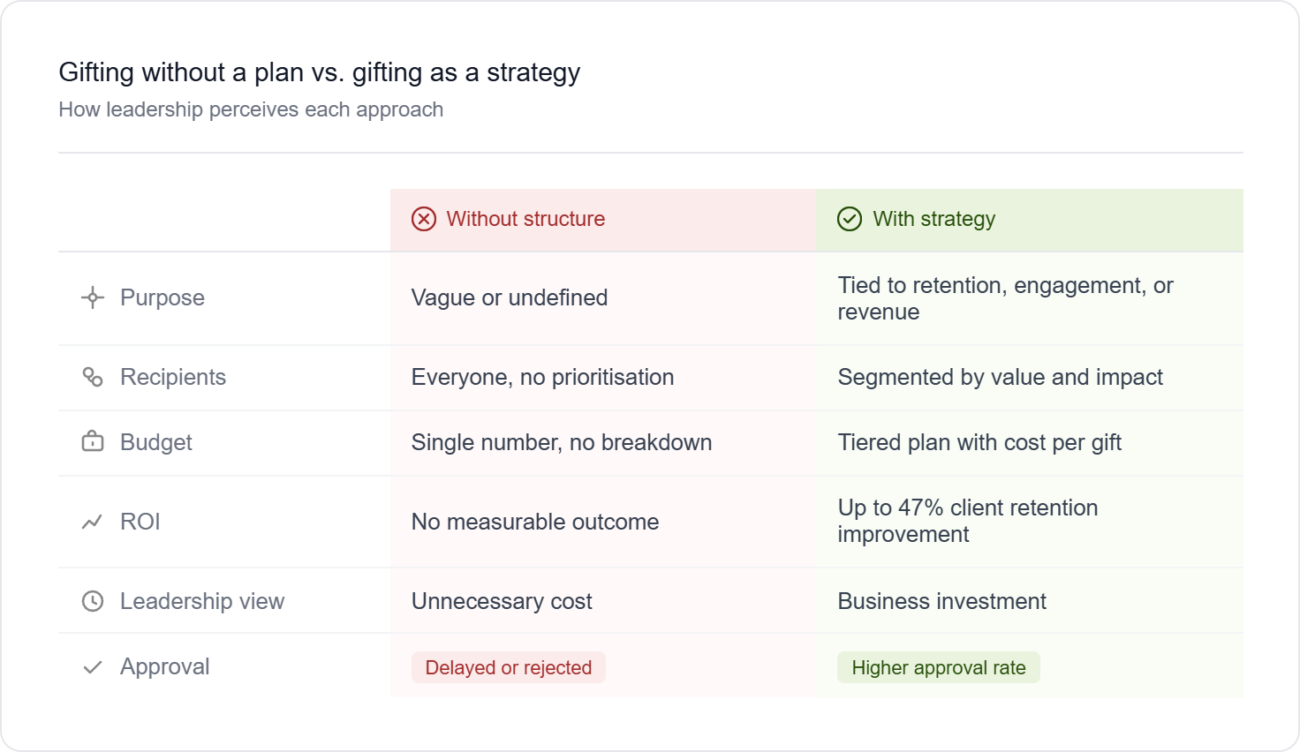
A clear and structured budget is essential for approval. Instead of presenting a large number without explanation, you should break the budget into simple and logical components. Start by estimating how many people will receive gifts and how many times gifting will happen in a year. Then assign a reasonable cost per gift and calculate the total budget.
For example, you can explain that 200 employees receiving gifts across three occasions with a defined cost per gift leads to a predictable annual expense. This makes the proposal easy to understand and evaluate. Many companies follow this structured method to calculate their gifting budgets based on volume and frequency.
You can also support your numbers with industry benchmarks, where many companies in India typically spend between ₹500 and ₹2,000 per employee gift, depending on the occasion and purpose.
👉 Need help? Explore our guide on: How much should you spend on corporate gifting?
5. Offer budget options
Instead of presenting a single fixed budget, it is more effective to offer multiple options. This approach gives leadership flexibility and increases the likelihood of approval. You can create different tiers, such as basic, standard, and premium, each with a clear explanation of what it includes.
For example, a basic plan may cover only essential occasions like onboarding and festivals, while a premium plan may include personalized gifts, performance rewards, and client engagement programs.
Providing options helps decision makers feel in control, as they can choose a plan that fits the company’s financial situation. It also shows that you have thought through different scenarios and are not rigid in your approach. This flexibility often reduces resistance and speeds up the approval process.
At TapWell, we have corporate gifting options for every budget. Explore them:
- Corporate Gifts Under ₹50
- Corporate Gifts Under ₹100
- Corporate Gifts Under ₹300
- Corporate Gifts Under ₹500
- Corporate Gifts Under ₹1000
- Corporate Gifts Under ₹2000
6. Suggest cost control ideas
Budget approval becomes much easier when you proactively address cost concerns. You should clearly explain how you plan to manage expenses without reducing impact. For example, bulk purchasing can reduce the cost per gift, while vendor partnerships can provide better pricing and logistics support. You can also suggest a tiered gifting model, where high-value stakeholders receive premium gifts, and others receive standard gifts.
This approach ensures that the budget is allocated efficiently and delivers maximum value. Many organizations use tiered allocation strategies to focus their spending on high-impact groups while maintaining overall cost control.
When leadership sees that you are focused on optimization and not just spending, they are more likely to approve the budget.
7. Align with company culture
Your proposal should always reflect the company’s culture and priorities. This makes it more relevant and easier to support. For example, if the company emphasizes employee experience, you should highlight how gifting improves recognition and engagement. If the company is focused on growth and revenue, you should emphasize how gifting supports client retention and relationship building.
Aligning your proposal with company values helps position gifting as part of a larger strategy rather than a standalone activity. It also shows that you understand the organization’s priorities and are building your plan accordingly. This alignment plays a key role in gaining leadership support.
8. Present timing and execution plan
A strong proposal does not stop at ideas. It clearly explains how and when the plan will be executed. You should outline key occasions such as onboarding, employee milestones, festivals, and client appreciation events. You should also explain how gifts will be selected, procured, and delivered.
Planning timing in advance helps avoid last-minute costs and ensures smoother execution. It also allows better negotiation with vendors and more thoughtful selection of gifts. When leadership sees a clear execution roadmap, they gain confidence that the budget will be used effectively and without operational issues.
9. Prepare a one-page proposal

Even though your thinking is detailed, your final proposal should be simple and easy to read. Decision makers prefer concise documents that clearly present key information. Your proposal should include the objective, target audience, budget breakdown, expected outcomes, and timeline in a structured format.
Most companies today follow defined gifting budgets and structured planning processes, which shows that this is a standard and accepted business practice.
👉 Corporate Gifting Strategy: Plan, Measure ROI and Gifts
10. Close with a clear recommendation
The final step is to present a clear recommendation. Instead of leaving the decision open ended, you should suggest the most suitable option based on your analysis. For example, you can recommend a standard plan that balances cost and impact while covering both employees and clients.
A clear recommendation shows confidence and reduces decision fatigue for leadership. It also helps move the discussion toward approval rather than prolonged evaluation. When you combine a strong recommendation with clear data and structured planning, the chances of approval increase significantly.
Here’s an email template you can simply copy and send to your founder or key decision maker in the company:
Subject: Approval Request: Corporate Gifting Budget
Hi [Founder’s Name],
I would like to propose a structured corporate gifting budget to improve employee engagement and strengthen key client relationships.
A planned approach can help us improve retention, recognition, and loyalty. Gift studies show gifting programs can improve client retention by up to 47%, which directly impacts revenue.
The plan will cover employee gifting during onboarding, work milestones, and performance recognition, along with gifting for high-value and long-term clients. The proposed budget is ₹[X], based on number of recipients and key occasions, with cost controls through bulk purchasing and tiered allocation.
For execution, I recommend using TapWell, a trusted corporate gifting platform with 4000+ gift options across budgets and occasions.
Please let me know if I can share a quick breakdown.
Thanks,
[Your Name]
Final takeaway
Corporate gifting is most effective when it is intentional, structured, and measurable. It is not about the cost of the gift, but about the value it creates for employees, clients, and the business as a whole. Even modest budgets can deliver strong results when used strategically.
The key to approval is simple. You need to clearly show why the budget is needed, how it will be used, and what outcomes it will deliver. When you present gifting as a business investment with clear returns, leadership is far more likely to approve it.