

Planning Diwali gifts for your clients, partners, or employees?
We’ll help you choose Diwali gifts that fit your budget and brand—quick, simple, and hassle-free. Just reach out to our team and we’ll take care of the rest.
 4.8 out of 5 ★★★★★ by 1100+ brands
 India is now registering over 20,000 new companies every month, with recent data crossing 24,000 in 2026. This is more than double the long-term average since 2013 and shows how fast business formation is growing in the country.
This growth reflects rising entrepreneurship, better digital processes, and strong demand across sectors. But it also brings new pressure. More competition, higher failure rates, and faster market shifts are now part of the business cycle.
In this article, we break down the latest company registration statistics in India using real data from 2026 and recent years. It answers key questions on monthly registrations, annual trends, company types, sector share, and state-wise growth. All data comes from verified research sources listed at the end.
Key company registration statistics in India (2026)
- India registered 24,140 new companies in February 2026, up from 23,280 in January
- Monthly registrations crossed 26,631 in December 2025, the highest on record
- The long term monthly average since 2013 is 10,699 companies, showing current levels are more than double
- India registered around 181,000 companies in FY25, slightly lower than FY24
- Private companies dominate with 23,981 registrations in Feb 2026, compared to just 159 public companies
- India recorded 973,090 closed companies in February 2026, the highest level so far
- Over 70% of new companies in FY25 came from the services sector
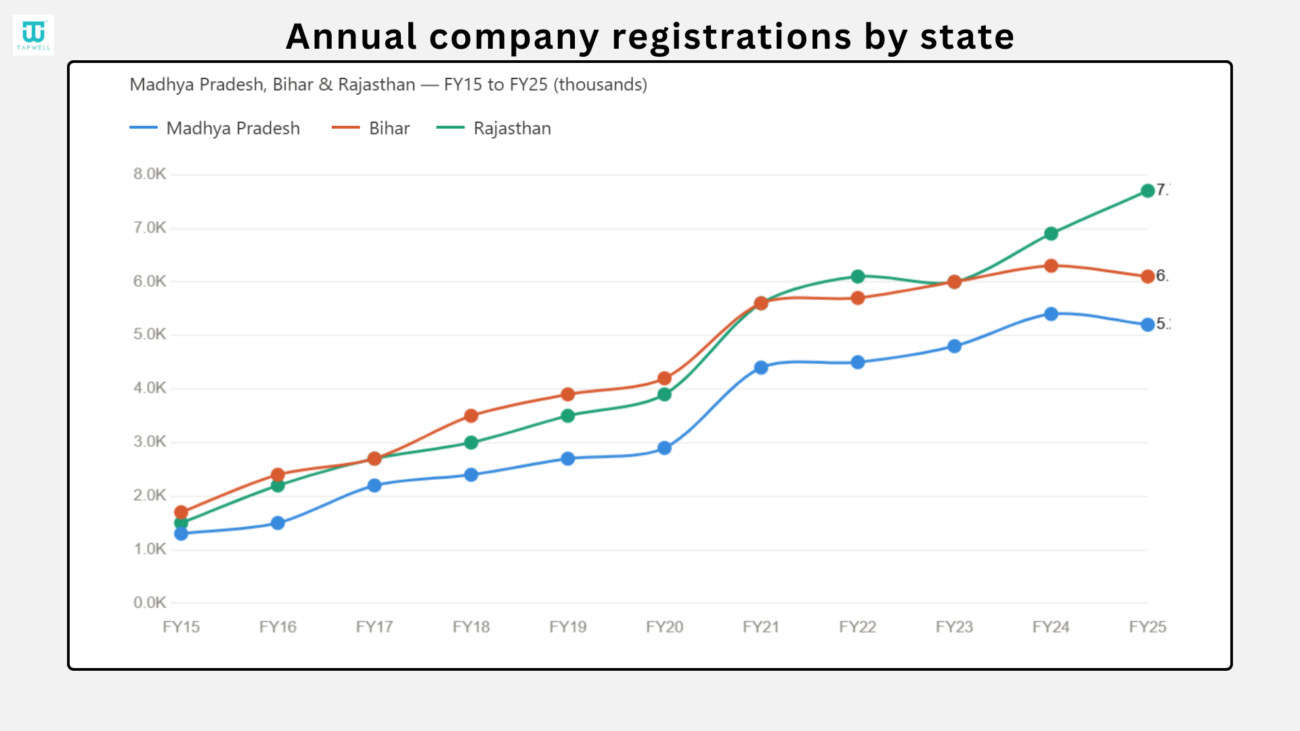
- Rajasthan (7.7K), Bihar (6.1K), and Madhya Pradesh (5.2K) saw strong growth in company registrations between FY15 and FY25
- Globally, there are 150 million+ startups, with around 50 million new startups each year
- SMEs make up 90% of global businesses, contributing nearly 50% of global GDP
How many companies are registered in India in 2026, and what is the trend?
India registered 24,140 new companies in February 2026, up from 23,280 in January 2026. This shows a clear month-on-month increase in company registrations. The upward movement suggests that business activity is stable and growing in 2026.
Looking at the broader trend, company registrations reached a peak of 26,631 in December 2025, which is the highest monthly figure recorded. At the same time, the long-term monthly average stands at around 10,699 companies since 2013, which shows that current levels are much higher than past averages
On the lower end, registrations had dropped to 765 in April 2014, which highlights how much the market has expanded over time
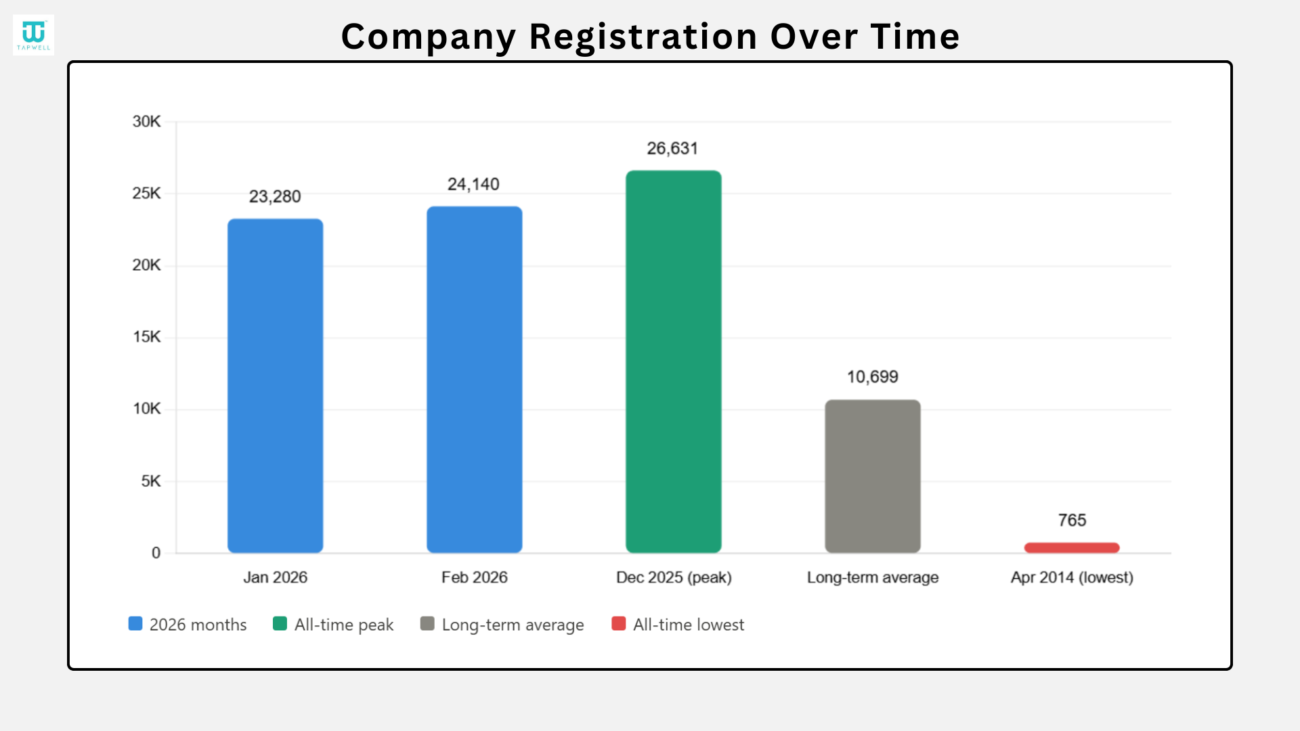
This is not just steady growth. It shows that India has entered a high-activity phase of business formation. Registrations are now consistently above long term levels, which means starting a company is faster and more accessible than before.
At the same time, high entry also means higher competition. More companies are entering the same markets, which can reduce margins and increase pressure on new businesses to survive.
What types of companies are registered in India (private vs public)?
India registered 23,981 private companies and 159 public companies in February 2026, up from 23,124 private and 156 public companies in January 2026.
Private company registrations have reached a peak of 26,466 in December 2025 and dropped to a low of 738 in April 2014. The long-term monthly average for private company registrations stands at 10,383 companies since 2013.
Public company registrations remain much lower, with a monthly average of 282, a peak of 615, and a low of 27.
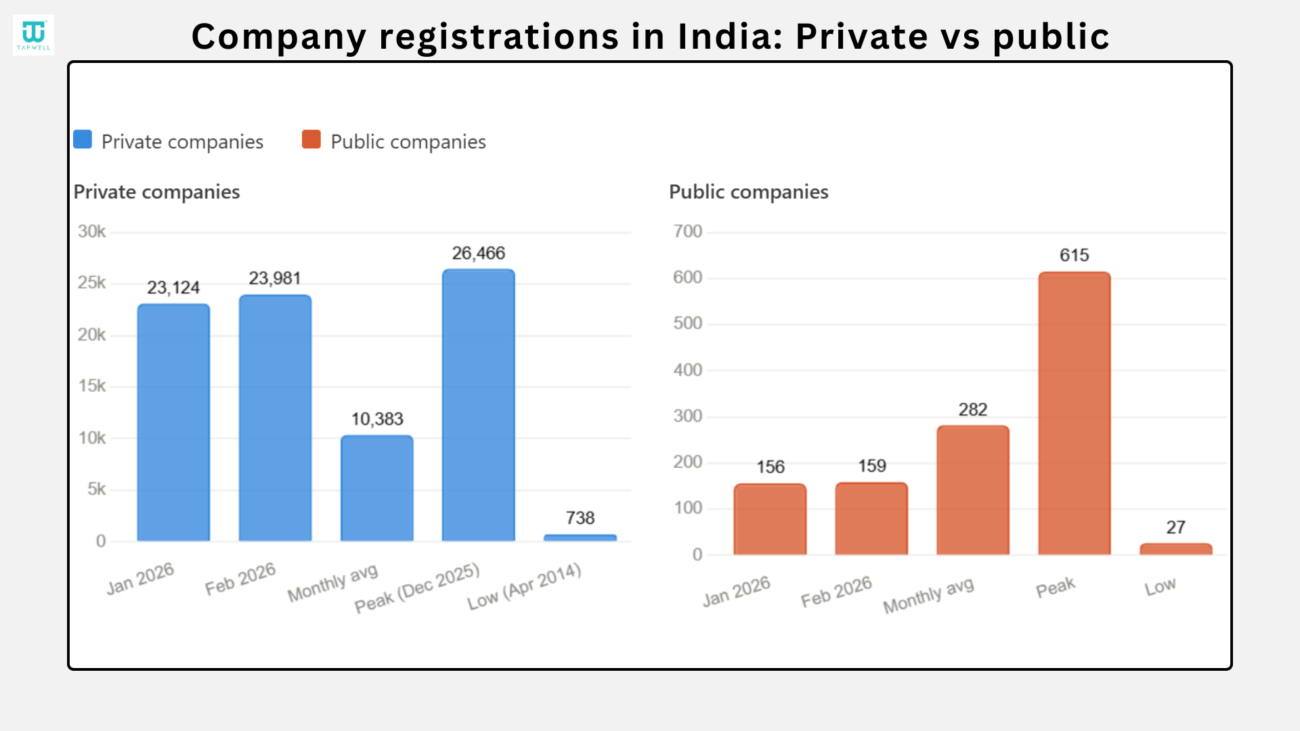
Gap shows that India’s startup ecosystem is built on small, flexible business structures. Most founders prefer speed and control over scale and compliance. It also means that a large share of new companies may stay small or early stage, rather than scaling into large public businesses.
How many companies are closing in India?
India recorded 973,090 closed companies in February 2026, up from 972,078 in January 2026. The long-term average is 749,312 closed companies, with the lowest level at 268,142 in March 2015. February 2026 is also the highest recorded level of company closures.
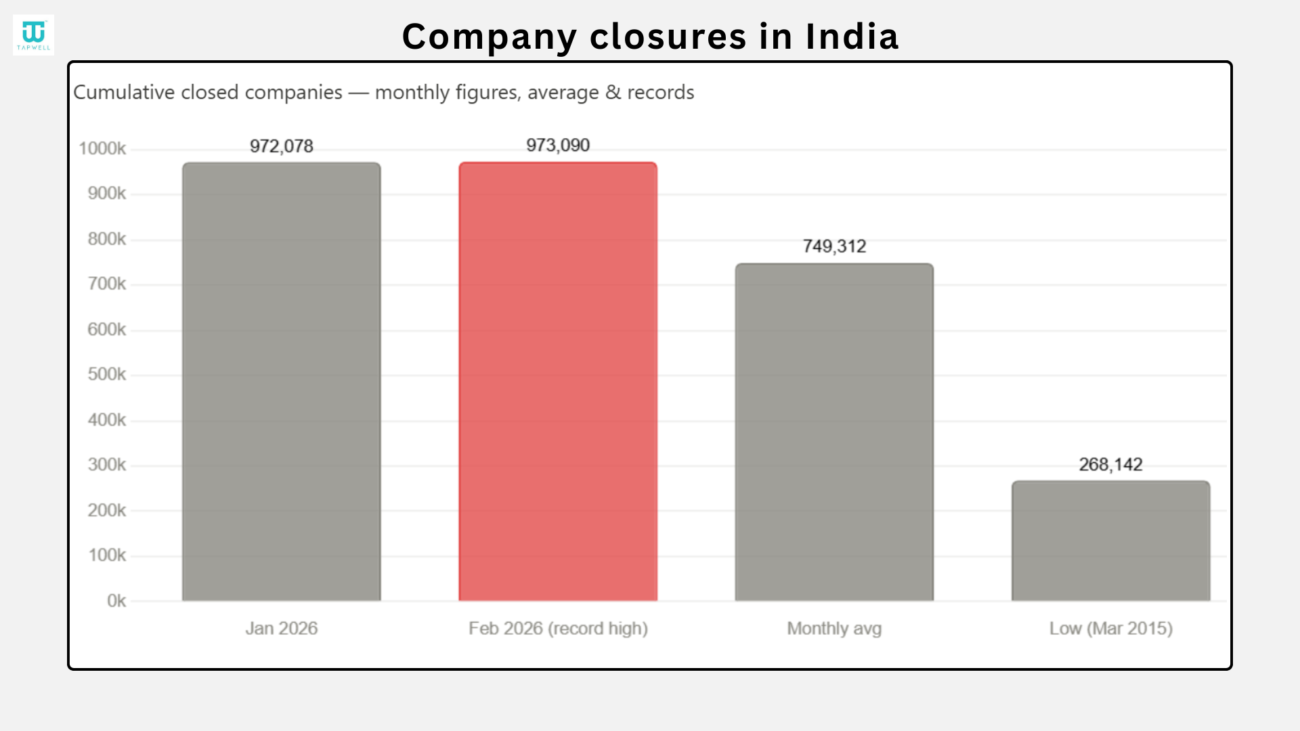
The rise in closures is not just a result of more companies existing. It also signals higher churn in the market. More businesses are entering, but many are also exiting quickly. This points to a trial-and-error startup environment, where survival depends on speed, funding, and product fit.
How many companies are registered annually in India?
Around 181,000 companies were registered in India in FY25, which is about 2% lower than FY24.
In monthly terms, registrations reached 21,157 in March, which is the highest monthly figure reported for that year. The previous high was 17,679 in February.
Annual registrations remain strong even with a slight drop compared to the previous year. Monthly spikes indicate that business formation stays active throughout the year, with some months showing sharp increases.
Which sectors have the highest company registrations in India?
In FY25, more than 70% of all newly registered companies in India came from the services sector, compared to about 65% in FY23
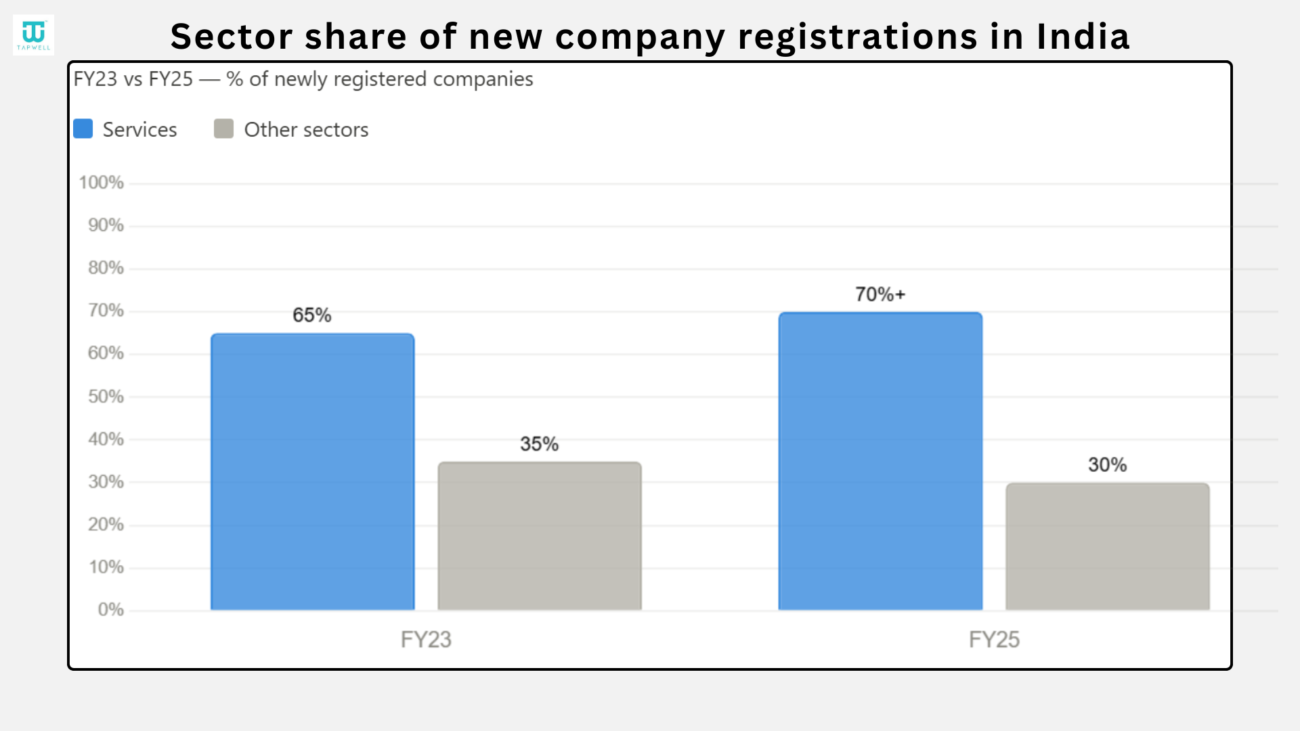
The share of service-based companies has increased in recent years. This includes sectors like IT services, consulting, finance, and digital businesses.
This shift towards services shows that India’s growth is becoming digital-first and asset-light. More founders are choosing business models that need less capital and can scale faster. But this also leads to crowded markets, especially in IT and online services.
Which states have the fastest company registration growth in India?
Rajasthan reached about 7.7K company registrations in FY25, up from around 1.5K in FY15. Bihar grew to about 6.1K from 1.7K, and Madhya Pradesh increased to 5.2K from 1.3K over the same period.
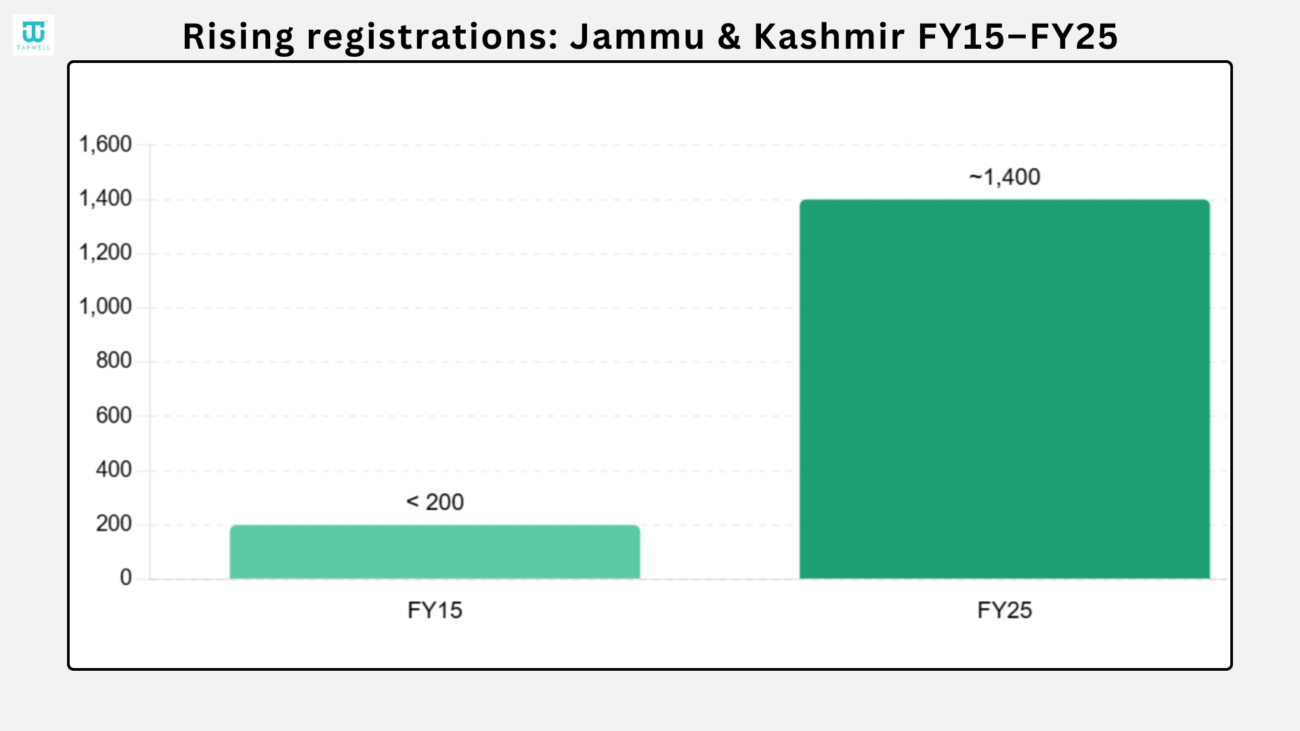
Jammu and Kashmir also recorded strong growth, rising from fewer than 200 companies in FY15 to nearly 1,400 in FY25.
West Bengal has not kept pace with this growth. In FY15, West Bengal had registrations similar to the combined total of Rajasthan, Bihar, and Madhya Pradesh. By FY25, these three states together register more than twice the number of companies compared to West Bengal.
Now, business growth is moving beyond metro cities into lower-cost, emerging regions. States with lower costs and less competition are now attracting more founders, which can reshape India’s startup map in the coming years.
What are the global company registration trends?
There are over 150 million startups worldwide, with around 50 million new startups launched each year.
Small and medium-sized enterprises (SMEs) make up about 90% of all businesses globally, employ around 70% of the workforce, and contribute nearly 50% of global GDP.
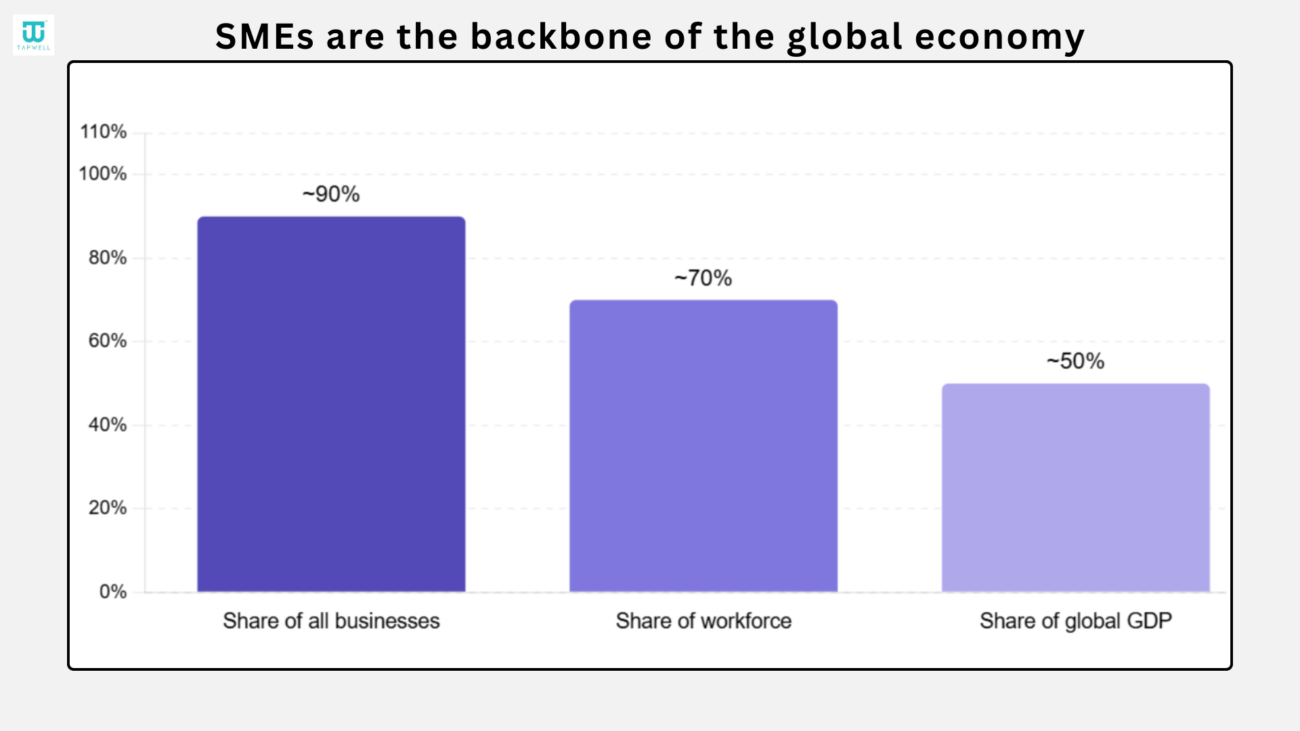
Global data shows that while starting a business is easier than ever, scaling remains the real challenge. Most companies stay small, which means success depends less on starting and more on execution, differentiation, and long-term survival.
Final words: What this growth means for businesses
India is seeing consistent growth in new company registrations, with strong monthly activity and rising participation across sectors and states
As more companies register and teams expand, hiring and onboarding happen faster than before. This creates a need for structured systems that support employee experience at scale. Without clear processes, tasks like onboarding, rewards, and engagement can quickly become inconsistent across teams.
Businesses now focus more on employee onboarding, engagement, and long-term retention. These areas directly impact productivity and brand perception. Many companies now use structured gifting to support:
- new employee onboarding
- rewards and recognition
- festive and milestone campaigns
- client and partner engagement
As teams scale, handling gifting manually becomes difficult. Companies need systems that support bulk orders, custom branding, and delivery across locations.
This is where TapWell helps businesses manage corporate gifting in a simple and scalable way. With over 4,000+ product options, custom branding, and PAN India delivery, TapWell supports companies at every stage of growth
If your company is growing, setting up a structured gifting system early can improve employee experience and strengthen business relationships.
Data Sources
- https://www.ceicdata.com/en/india/company-registration-overview
- https://thisweekindata.indiadatahub.com/p/record-company-registration-data
- https://www.weforum.org/stories/2026/01/driving-global-growth-through-the-power-of-small-business/
- https://corporate.visa.com/en/sites/visa-foundation/economic-inclusion.html
- https://creately.com/blog/culture/challenges-faced-by-startups/
- https://www.ons.gov.uk/businessindustryandtrade/business/activitysizeandlocation/bulletins/businessdemographyquarterlyexperimentalstatisticsuk/januarytomarch2025?anr=warning&anrId=3543088556.6d2363b48a2e2a8f63c64c017fc03fce#business-creations
- https://www.insee.fr/en/statistiques/8743257