


Planning Diwali gifts for your clients, partners, or employees?
We’ll help you choose Diwali gifts that fit your budget and brand—quick, simple, and hassle-free. Just reach out to our team and we’ll take care of the rest.
 4.8 out of 5 ★★★★★ by 1100+ brands
 Employee retention is shaped by factors such as compensation, recognition, workplace culture, career growth, and employee wellbeing.
This statistical roundup compiles the latest employee retention statistics across these areas, along with insights into turnover costs, AI adoption, and country-level retention trends. Whether you’re benchmarking your HR strategy or researching workforce trends, these figures provide a clear snapshot of the current landscape.
We’ve also included the original data sources at the end of this article for your reference.
Top Employee Retention Statistics to Know in 2026
- Companies rated highly for employee benefits and compensation experience have 56% lower employee attrition.
- More than 8 in 10 employers say financial wellness resources improve employee retention, job satisfaction, and productivity.
- 59% of employees worldwide report feeling stressed at work, while 57% do not feel happy at work most of the time.
- Employees with high-trust leaders are four times more committed to their company.
- Employees who receive meaningful recognition are 65% less likely to actively look for another job.
- 53% of the workforce is considering new job opportunities.
- Only 23% of organizations describe their employee retention strategy as advanced or top-notch.
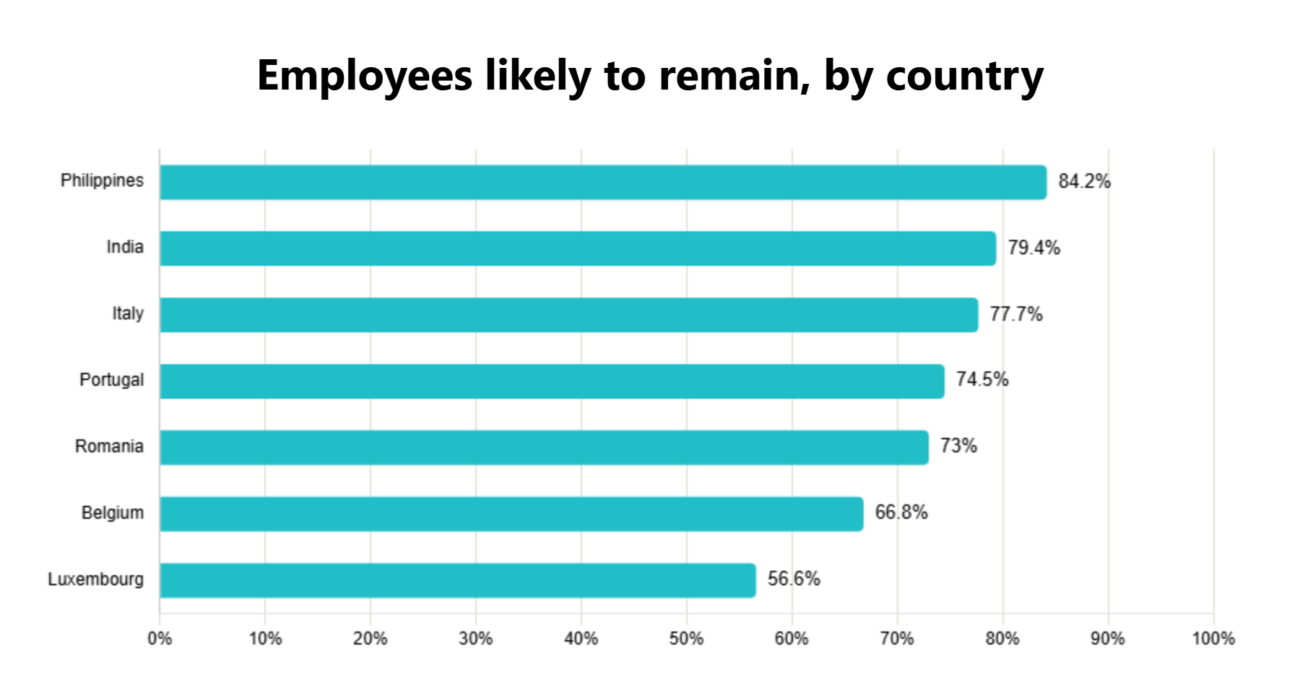
- The Philippines reported one of the highest employee retention rates, with 84.2% of employees likely to remain, while Luxembourg recorded the lowest at 56.6%.
- Employee voluntary turnover costs U.S. employers nearly $1 trillion every year.
- Replacing a leader or manager costs organizations approximately 200% of their annual salary.
General employee retention statistics
Employee retention continues to shape hiring, workforce planning, and business performance. These benchmarks show how organizations prioritize retention, where turnover stands today, and what separates high-performing employers from the rest.
- Employee retention is a top three priority for 63% of top leaders, 60% of line managers, and 57% of HR professionals.

- Only 23% of organizations describe their employee retention strategy as advanced or top-notch.
- Retention leaders are twice as likely as retention laggards to rank retention as their organization’s highest priority (24% vs. 12%).
- 31% of organizations report a voluntary employee turnover rate of 20% or higher over the past 12 months.
- Nearly half of retention-leading organizations keep voluntary turnover below 10%, while 58% of organizations report turnover above their industry average.
Employee benefits and compensation statistics
Competitive pay alone is no longer enough to keep employees. Benefits, workplace flexibility, financial wellbeing, and fair compensation all influence whether employees choose to stay or look elsewhere.
- Companies rated highly for employee benefits and compensation experience have 56% lower employee attrition, highlighting the impact of competitive rewards on long-term retention.
- More than 8 in 10 employers say financial wellness resources improve employee retention, along with job satisfaction, productivity, hiring quality, and employer reputation.
- 75% of employers say flexible working is one of the most effective benefits for achieving business objectives.

- Among small and medium businesses, 76% agree, yet only 40% currently offer flexible work arrangements, showing a significant gap between employer expectations and workplace practices.
- 64% of millennials want greater flexibility in when and where they work, making flexible work a key factor for retaining younger employees.

- 81% of organizations believe employers have a responsibility to provide employees with a fair and livable income, reinforcing the growing importance of competitive compensation in employee retention.
- While 48% of organizations conduct compensation benchmarking studies and 41% have increased employee pay to reduce turnover, only 16% offer retention or stay bonuses.
Employee engagement and workplace culture statistics
Employees are more likely to stay when they trust leaders, feel valued, and find purpose in their work. The numbers below reveal how workplace culture affects commitment, satisfaction, and retention.
- 59% of employees worldwide report feeling stressed at work. At the same time, 48% do not believe their work has a clear sense of purpose, while 57% do not feel happy at work most of the time.

- Employees with high-trust leaders are four times more committed to their company, highlighting the important role leadership plays in improving employee retention.
- Employees who receive meaningful recognition are 65% less likely to actively look for another job. However, only 22% say they receive the right amount of recognition from their employer.
- 53% of the workforce is considering new job opportunities, while 76% of job seekers prefer companies certified as great workplaces, showing that workplace culture and employer reputation strongly influence career decisions.
Employee development and career growth statistics
Opportunities to learn and grow often determine whether employees build a long term career with an organization. These findings connect skill development and employee tenure with retention outcomes.
- 62% of organizations believe they have a responsibility to invest in employee skill development.

- Employees with 2 to 5 years of tenure have the lowest intention to remain with their employer.
- Employees with 10 or more years of tenure report the highest intention to stay.
Employee retention strategies and measurement statistics
Many employers have introduced retention initiatives, but fewer evaluate their effectiveness. This collection highlights the strategies organizations use, the metrics they monitor, and the gaps that still exist.
- 45% of organizations focus on creating a strong onboarding experience, 45% encourage open and transparent communication, and 42% invest in employee wellbeing and mental health.

- Only 49% of employers prioritize employee listening through surveys and focus groups.
- 84% of organizations rely primarily on exit interviews, showing that most still use a reactive approach to retention.

- Only 18% conduct stay interviews to identify retention risks before employees resign.
- 65% track the reasons employees leave.
- Only 46% measure employee engagement, despite it being a leading indicator of turnover.
- Only 20% track turnover by demographic group.
- Just 16% measure the financial cost of employee turnover.
- Organizations should aim for at least a 15% annual improvement in employee turnover until they reach or outperform their industry’s turnover benchmark.
- After reaching the industry benchmark, organizations should target an additional 5% to 10% annual improvement in turnover.
AI in employee retention statistics
AI is expanding beyond automation into employee experience. Organizations increasingly see it as a way to personalize learning, identify skill gaps, and provide faster HR support that helps retain talent.
- 53% of HR professionals believe AI can identify employee skill gaps and recommend targeted training.

- 49% believe AI can personalize employee learning and development.
- 45% believe AI can provide immediate HR support to employees.
Employee retention statistics by country
Employee commitment is not consistent across global markets. These comparisons reveal which countries report stronger retention, where passive employees are most common, and how turnover intentions vary internationally.
- The Philippines recorded one of the strongest retention rates, with 84.2% of employees likely to remain and only 6.0% likely to leave.
- India reported 79.4% of employees likely to remain, with only 10.2% classified as passive.
- China had only 7.2% of employees likely to leave, but 22.9% were passive, the highest passive share in the study.
- Luxembourg recorded the weakest retention rate, with only 56.6% of employees likely to remain and 25.3% actively planning to leave.
- Portugal (74.5%), Italy (77.7%), Romania (73.0%), and Belgium (66.8%) all reported employee retention rates above two-thirds of their workforce.
- In the United States, only 8.8% of employees are likely to leave, but 19.5% are passive employees, suggesting many remain without being fully engaged.
Employee turnover cost statistics
Replacing employees affects far more than recruitment budgets. The following estimates illustrate how turnover impacts business costs, productivity, and long-term financial performance across different roles.
- Employee voluntary turnover costs U.S. employers nearly $1 trillion every year.
- McKinsey estimates employee disengagement and attrition cost a median-sized S&P 500 company more than $228 million annually.
- 45 million U.S. workers voluntarily left their jobs in 2023.

- Replacing an employee typically costs 19% to 40% of the employee’s base salary, depending on the role.
- Replacing leaders and managers costs organizations approximately 200% of their annual salary.
- Replacing employees in technical roles costs around 80% of their annual salary.
- Replacing frontline employees costs about 40% of their annual salary.
Final words
Employee retention depends on consistent investment in people, not just competitive salaries. The statistics above show that recognition, career growth, workplace culture, and meaningful employee experiences all influence whether people stay.
Looking for employee gifting ideas? Contact TapWell for expert recommendations.
One practical way to reinforce those experiences is through thoughtful corporate gifting. Whether you’re welcoming new hires, celebrating work anniversaries, rewarding top performers, or recognizing milestones, TapWell helps businesses strengthen employee engagement with over 4,300 customizable corporate gifts, branded welcome kits, and PAN India delivery. We are trusted by 1,000+ brands, which makes it easy to create memorable employee experiences that support long-term retention and workplace loyalty.
👉 TapWell Reviews | What Our Corporate Gifting Clients Say
FAQs
What are the biggest factors affecting employee retention?
Companies with highly rated employee benefits and compensation experience report 56% lower employee attrition. Beyond pay, factors such as employee recognition, career development, workplace flexibility, leadership quality, and a positive work culture all contribute to stronger long-term retention.
Does employee recognition improve employee retention?
Employees who receive meaningful recognition are 65% less likely to actively search for another job. Despite this, only 22% of employees feel they receive the right amount of recognition, making appreciation one of the simplest ways to improve retention.
Does flexible work help improve employee retention?
Around 75% of employers consider flexible work one of their most effective employee benefits. Flexible work arrangements improve work-life balance and align with employee expectations, especially since 64% of millennials want greater flexibility in where and when they work.
How much does employee turnover cost businesses?
Replacing an employee typically costs between 19% and 40% of their annual salary, while leadership roles can cost up to 200%. Across the U.S., voluntary employee turnover costs employers nearly $1 trillion every year.
Why is workplace culture important for employee retention?
Employees with high-trust leaders are four times more committed to their organization. In addition, 76% of job seekers prefer employers recognized as great workplaces, showing that leadership and culture play a major role in attracting and retaining talent.
How do organizations measure employee retention?
About 84% of organizations rely on exit interviews to understand employee turnover. However, only 18% conduct stay interviews, while 46% measure employee engagement, suggesting many employers focus more on departures than ongoing retention.
Can AI help improve employee retention?
Around 53% of organizations believe AI can identify employee skill gaps that affect retention. Additionally, 49% say AI can personalize learning, while 45% believe it can provide immediate HR support, helping improve employee experience and career development.
Data Sources
- https://www.gallup.com/file/workplace/707798/state-of-the-global-workplace-2026-download.pdf
- https://www.hr.com/en/resources/free_research_white_papers/hrcoms-state-of-employee-retention-2025-26_mh1v0oy3.html
- https://www.greatplacetowork.com/resources/reports/employee-retention-strategies#2997
- https://info.workinstitute.com/hubfs/2024%20Retention%20Report/Work%20Institute%202024%20Retention%20Report.pdf
- https://www.gallup.com/workplace/650174/employee-retention-depends-getting-recognition-right.aspx