

Planning Diwali gifts for your clients, partners, or employees?
We’ll help you choose Diwali gifts that fit your budget and brand—quick, simple, and hassle-free. Just reach out to our team and we’ll take care of the rest.
 4.8 out of 5 ★★★★★ by 1100+ brands
 Ecommerce market in India is growing fast, but a large number of internet users still do not shop online, creating a clear gap between digital access and actual buying behavior.
As a result, businesses struggle to understand where real growth is coming from and which trends actually matter.
In this listicle roundup, we break down the most important India e-commerce statistics for 2026 to help you understand the market, users, and future direction.
METHODOLOGY:
This article uses data from the Bain & Company and Flipkart report, “How India Shops Online.” Data comes from industry analysis, company insights, and government-backed sources such as the RBI and MoSPI. Our editorial team selected and simplified key statistics to present clear, accurate, and easy-to-understand insights without adding assumptions.
Key ecommerce statistics from the Indian market at a glance:
- India’s e-commerce market is projected to grow from $65–66 billion in 2025 to $170–180 billion by 2030, more than doubling in five years.
- India has only ~30% online shopping penetration among internet users, which means the majority of digital users are still not buying online.
- Over 850 million Indians are already active online, yet a large share of them still use the internet only for content and social media, not for shopping.
- Around 2 out of every 3 social media users in India have never made an online purchase, highlighting a massive untapped e-commerce opportunity.
- Gen Z makes up 40%–45% of all online shoppers in India, making it the most influential consumer group in the market.
- Nearly 50% of new e-commerce orders come from Gen Z users, showing that younger consumers are driving most of the growth.
- Tier 2 and smaller cities contribute to about 50% of new e-commerce orders, proving that growth is now driven by non-metro India.
- Quick commerce already accounts for 16%–17% of India’s total e-commerce market, showing how fast delivery is reshaping online shopping.
- Conversion rates in quick commerce are 8 times higher than traditional e-commerce, because users typically shop with clear intent and urgency.
- E-commerce currently contributes only ~1.6% to India’s GDP, which highlights how early the market still is compared to global leaders.
Market Size and Growth
India’s e-commerce market is expanding at a fast pace due to rising digital access, better logistics, and higher consumer spending. Growth has become more stable after the pandemic phase, and 2026 shows strong momentum.
The market still has large untapped potential compared to global leaders, which makes it one of the most promising digital economies.
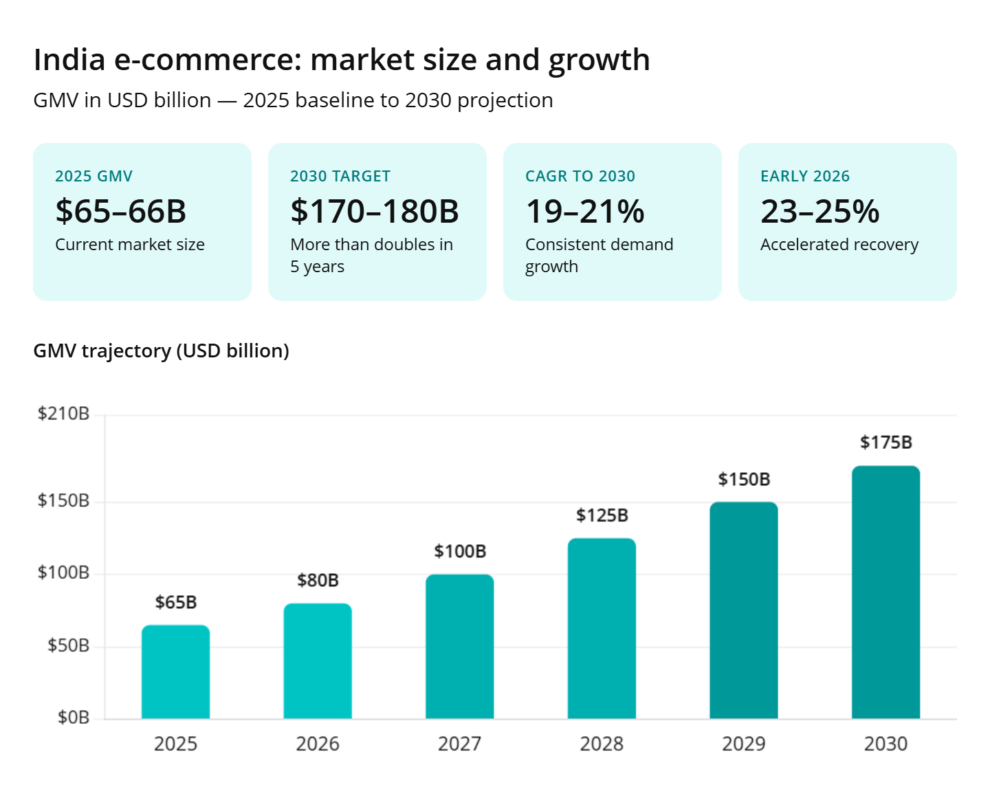
- India’s e-commerce market reached $65–66 billion in GMV in 2025, showing that online retail has already achieved large-scale adoption across categories like electronics, fashion, and grocery.
- The sector is growing at a 19%–21% annual rate, which shows consistent demand growth and increasing consumer trust in online shopping platforms.
- E-commerce growth accelerated to 23%–25% in early 2026, indicating strong recovery in consumer spending after earlier slowdowns.
- The market is projected to reach $170–180 billion by 2030, meaning it will more than double as more users and categories shift online.
- India’s e-commerce market is expected to maintain 20%+ CAGR until 2030, making it one of the fastest-growing global e-commerce markets.
Users and Market Penetration
India has a large base of internet users, but only a small portion actively shops online. This gap creates a strong opportunity for future growth. As digital literacy improves and trust increases, more users are expected to start buying online, especially from smaller cities.
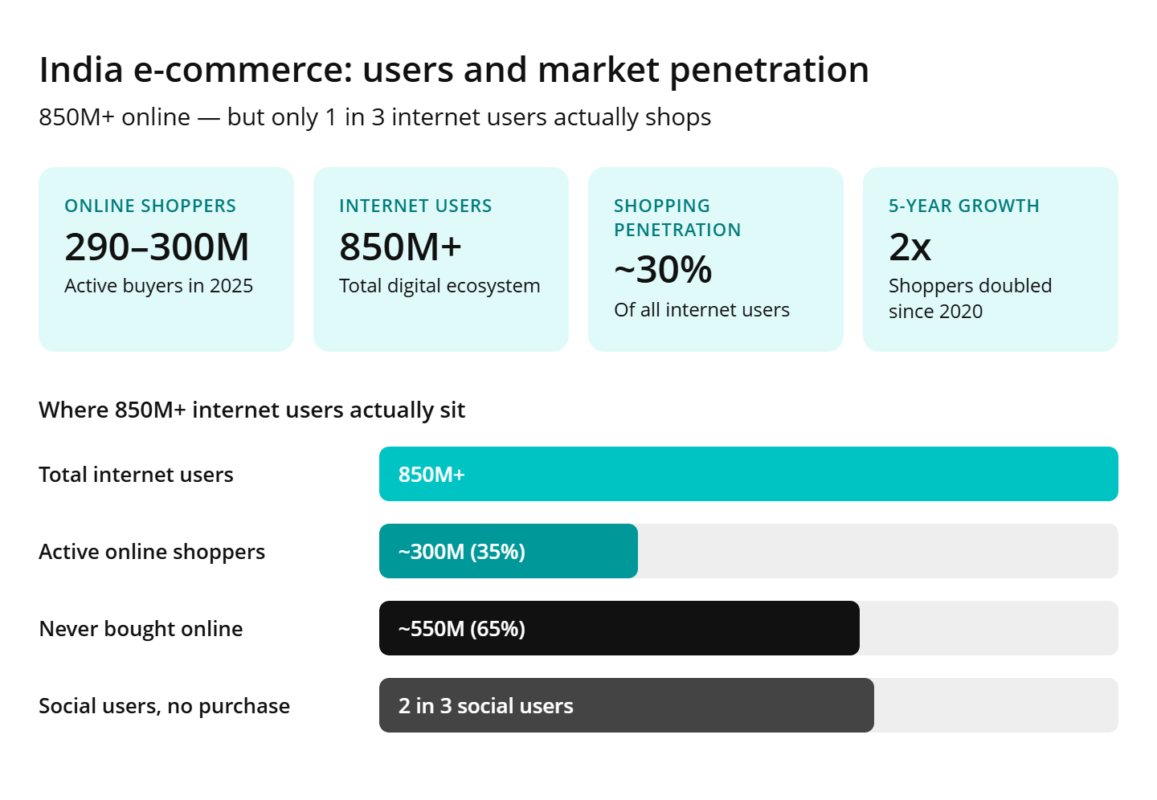
- India has 290–300 million online shoppers in 2025, showing that a large number of users have already adopted online buying across multiple categories.
- The number of online shoppers has doubled in the last five years, which shows rapid digital adoption and improved access to online platforms.
- Only around 30% of internet users in India shop online, which means a majority of users are still not converted into buyers.
- Over 850 million users are already part of the digital ecosystem, but many of them use the internet only for social media or content consumption, not shopping.
- Around 2 out of every 3 social media users have not made an online purchase yet, showing a large untapped opportunity for e-commerce platforms.
Consumer Demographics and Growth Drivers
Growth in India’s e-commerce market is driven by specific user groups such as Gen Z, middle-income households, and users from smaller cities. These groups are shaping how people discover, compare, and buy products online. Their behavior is more mobile-first and influenced by social media trends.
- Gen Z accounts for 40%–45% of total online shoppers, making it the most dominant age group in India’s e-commerce market.
- Gen Z contributes to nearly 50% of all new online orders, showing that younger users are driving most of the growth.
- Tier 2 and smaller cities generate about 50% of incremental e-commerce orders, proving that growth is expanding beyond major metro cities.
- Shopper penetration in Tier 2+ cities is still only 25%–30% of internet users, which means there is strong room for future expansion.
- Middle-income households contribute to around 50% of new shoppers, driven by increasing income and affordability.
Market Contribution and Economic Impact
E-commerce is becoming an important part of India’s economy, but its current share is still low. This shows strong future potential as more spending shifts from offline to online. Economic growth and rising income levels will further boost online retail.
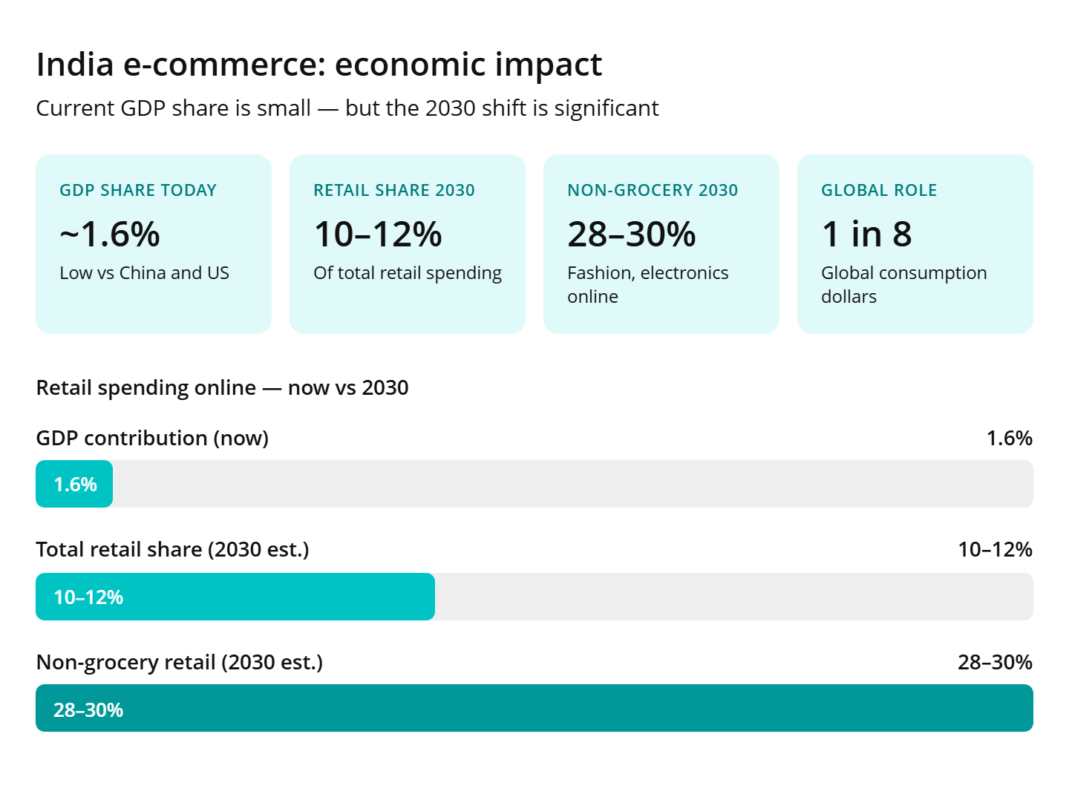
- E-commerce contributes only about 1.6% to India’s GDP, which is low compared to countries like China, showing early-stage development.
- By 2030, e-commerce is expected to contribute 10%–12% of total retail spending in India, showing a major shift toward digital buying.
- Online platforms will account for 28%–30% of non-grocery retail spending by 2030, highlighting strong adoption in categories like fashion and electronics.
- India is expected to contribute 1 out of every 8 global consumption dollars, making it one of the most important markets worldwide.
Quick Commerce Growth
Quick commerce is changing how people shop online by offering delivery within minutes. This model focuses on convenience and speed, especially for daily essentials. It is also helping increase online grocery adoption, which was previously low in India.
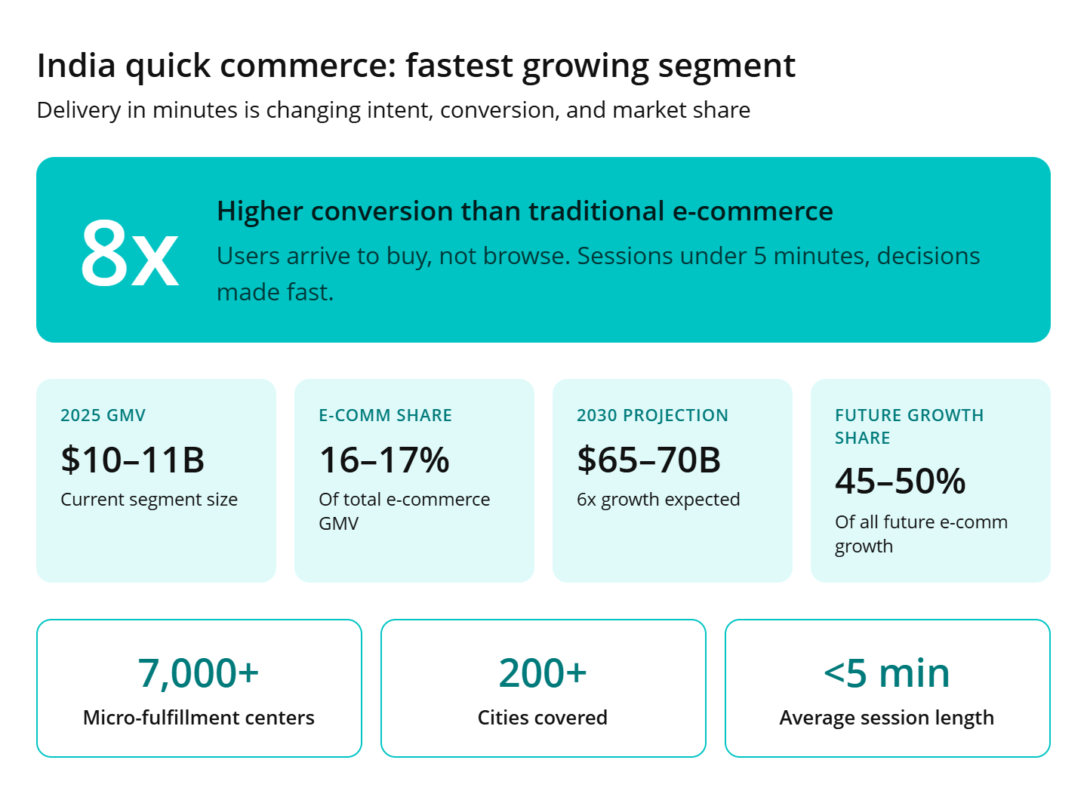
- Quick commerce reached $10–11 billion GMV in 2025, showing rapid adoption of fast delivery services.
- It contributes 16%–17% of total e-commerce GMV, making it a significant and growing segment.
- The segment is expected to grow to $65–70 billion by 2030, showing strong long-term demand for convenience shopping.
- Quick commerce is projected to drive 45%–50% of future e-commerce growth, making it a key contributor to market expansion.
- India has built over 7,000 micro-fulfillment centers across 200+ cities, enabling fast and efficient delivery networks.
Shopping Behavior Trends
Consumer behavior in India is evolving with better technology and convenience. Users now prefer faster delivery, simple payments, and personalized recommendations. These changes are improving user experience and increasing conversion rates.
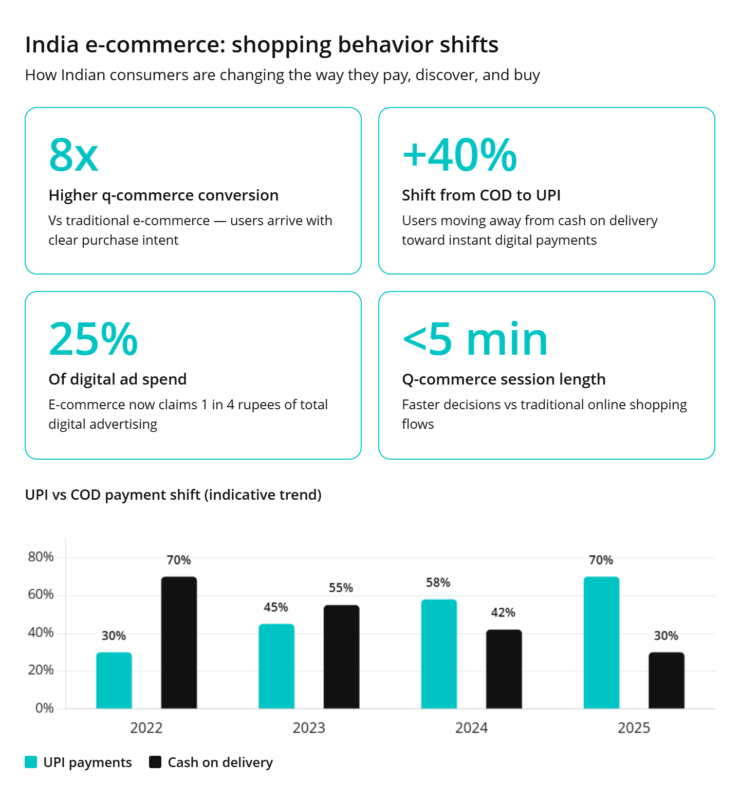
- Quick commerce sessions last less than 5 minutes, showing that users make faster purchase decisions compared to traditional online shopping.
- Conversion rates in quick commerce are 8 times higher than traditional e-commerce, because users have a clear intent to buy.
- There is a 40% increase in users shifting from cash on delivery to UPI payments, showing strong adoption of digital payments.
- E-commerce advertising now accounts for around 25% of total digital ad spending, showing that brands are investing more in online platforms.
💡 Explore our recent statistical articles:
- 30+ Interesting Gen Z Statistics
- 10+ Company Registration Statistics in India
- 30+ Business Spending Statistics 📈
Tapwell Corporate Gifting for the Growing E-commerce Market
As India’s e-commerce market grows, brands need stronger ways to engage customers and retain loyalty. Corporate gifting has become a key strategy to build relationships across online channels.
Tapwell helps e-commerce brands create impactful gifting experiences for customers, employees, and partners. We manage everything from product selection and customization to packaging and delivery at scale.
With Tapwell, businesses can turn transactions into long-term relationships through thoughtful and well-executed gifting solutions.
👉 Explore 4000+ corporate gifts for all budgets and occasions in India.